Submission to the Productivity Commission inquiry into Housing Supply Regulation On behalf of the Fitzroy Residents Association
Town after town felt interchangeable. Chains. Parking lots. Cheap builds. No trees…I wondered about the disappearance of family stores and the loss of community that comes with the Walmart culture. It made me question whether the built environment shapes how people imagine their future. If every day is spent in places that seem neglected, transactional and devoid of beauty, do people lose faith that things can get better? Former Federal Opposition Leader, Sussan Ley, writing in the AFR on her travels through the United States.
About this submission
This submission has been prepared by Michael Spencer (PhD, BA, Grad Dip Public Policy, Grad Cert Mgt) and Jenny Rizzo (B Arch Hons) on behalf of the Fitzroy Residents Association (FRA). FRA is one of Melbourne’s oldest resident associations. It was formed by people who were passionate about the built environment, sustainability and social equity. Among our early leaders were Brian Howe, later Deputy Prime Minister and a federal housing minister and Barry Pullen who became a Victorian Minister for Housing. It was formed in the wake of and in resistance to the social experiment of the Victorian Housing Commission demolishing inner Melbourne homes and communities to replace them with institutional high-rise apartments.
Main points
• Inner Melbourne is already on course to be more densely settled than inner London and on a par with Tokyo by 2050 • The Victorian Government has overturned years of work by local communities to streamline the planning system and reduce disputation, thereby opening the system to corruption
• Sadly, the Commission refers to these reforms as welcome reforms
• Narrow scope of the Terms of Reference and the Inquiry likely to lead to perverse outcomes and are contrary to contemporary thinking on good public administration
• The Commission should think in terms of social outcomes; denser, liveable and sustainable communities rather than a narrow focus on units of housing
• The Commissioner should disclose her interest as a former CEO of the Grattan Institute that is closely aligned with YIMBY Melbourne advocacy group
• The Commission should avoid generalisations and comments such as many people can’t afford to live in their desired location– that has surely always been the case
• The increased cost of housing is not being driven by apartment costs which have remained flat over the past decade with many owners reporting losses on resale
• The increased cost of housing is being driven by demand for stand-alone house and land packages which as seen as preferable particularly by young families
• Committee for Melbourne survey found that to continue to pursue densification without regard to liveability will undermine buy-in for urban consolidation
• The Commission’s claim that changing regulation would increase the supply of housing without investigating other costs seems to be jingoistic rhetoric
• Planning and building regulation play an important role in spacial distribution of land uses, protecting private property, consumer protection, public safety and equity
• It is not correct to assume council and community involvement in planning causes delays and costs, there is evidence that it suits developers to have less certainty, specifically discretionary vs mandatory planning controls
• The goal of best practice housing regulation is a bureaucratic ambition, not a societal goal. It should focus on creating more densely developed liveable communities
• Best practice, as described, could result in places that seem neglected, transactional and devoid of beauty [where] people lose faith that things can get better?
• Calls for high-rise and mid-rise buildings in activity areas fail to consider the impact of wind and overshadowing on pedestrian traffic, vegetation and adjoining owners
• The Commission failed to consider the economic and social importance of heritage streetscapes that attract tourists and support community health and well-being
• Developer contributions are important to more than just infrastructure, in inner city areas they are vital for increasing open spaces essential for well-being
• Parking will still require some level of minimal parking to avoid congestion and transferring costs to neighbours of multi-unit developments
• Tree canopy and wind are important to liveability and should not be ignored
• The proposals here amount to a social experiment rather than addressing market failure, lack of innovation and productivity in the home construction industry
Context
Density in Yarra and Fitzroy
If Australia is to have a population of 40 million in a few decades, as the recently released intergenerational report predicts, adequate housing is crucial. The housing crisis has dominated public discussion for years – affordability is the buzzword and 1.2m new dwellings by 2030 the target. In Victoria the State Government has set population targets for local governments and the strategic planners at our local inner municipal area City of Yarra (where Fitzroy is located) have worked for 7 years (at least) to produce a series of Planning documents to reflect these targets.
The current population of City of Yarra as a whole is 101,356 people, with a target increase of 83,300 people (44,000 houses) over the next 25 years (2051). The current density of Yarra is 5190 people/square kilometre. Under the population target above, the density of Yarra will become 9470 people/square kilometre. However, the current population of Fitzroy is 12,135 and current density is 8370 people/square kilometre. Projected population of Fitzroy to 2050 is 20,000 with a density of 14,084 people/square kilometre. (The current density of London is 5782 people/square kilometre, with inner London 10,260 people/square kilometre, and the density of inner Tokyo is 15,700 people/square kilometre).

Planning for additional homes by 2050
Over the last 7 years, the strategic planners at the City of Yarra, in consultation with the community, have worked on new planning regulations to allow for sensible increase in density and population along transport corridors (known here as Activity Centres). These Built Form Overlay regulations mean that Fitzroy, the smallest suburb in Melbourne (1.42 square kilometres) is already home to intensified medium density development at:
• 4 activity centres - Johnston, Gertrude, Brunswick and Smith streets
• 2 peripheral arterial roads - Alexandra and Victoria parades
• Mixed Use pockets where medium density residential development is allowed in “back blocks” (situated behind the Activity Centre strips)
Mid-rise development has been under way in Fitzroy for more than 10 years often with disputes fought at the Victorian Civil Arbitration Tribunal (VCAT) costing both the community and developers money and time. The new Built Forum Overlays (previously known as Design and Development Overlays) were a response by Yarra Council to seek a level of consensus that would clarify requirements and alleviate disputes. After much investment in external professional advice and community consultation, the Yarra Planning Scheme Amendment C271 Fitzroy and Collingwood Built Form Controls was finally signed off by the Minister for Planning as recently as 30 July 2026.
The document had been specifically designed to streamline planning applications and to manage growth, importantly it reintroduced mandatory rules, and therefore certainty, for building heights and setbacks. The Government appointed Standing Advisory Committee rigorously tested that it would achieve the 2051 housing targets and in June 2026 recommended to the State Government that it be gazetted with the mandatory building heights and relevant setbacks as key to establish a clearer more effective planning system for the people of Fitzroy and Collingwood and developers alike.
But the Minister removed the mandatory requirements (becoming discretionary again) and gave herself the final word through the Development Facilitation Program. In doing so she ignored the advice of the Standing Advisory Committee, brushed aside seven years of work by Yarra Council, the community and developers and opened the Victorian planning system to corruption. This “behind closed doors” approach to planning is precisely the approach the Independent Broad-based Anti-corruption Commission warned about in their Project Sandon report. It is an approach that opens the planning system to corruption. Sadly, the Commission refers to these as “welcome reforms”. (p.5)
The Productivity Commission Report
Scope
While the Terms of Reference provided by the Treasurer were narrow to the point of being an answer looking for a question rather than a question looking for an answer, the Commission should still examine costs across the housing supply chain. This would mitigate the risk of perverse outcomes due to a narrow focus without context. A broader understanding of the obstacles to housing construction would allow the Commission to deliver a well-informed report and provide a perspective on the priority of the regulatory burden in comparison with other factors such as material and labour costs.
A well-constructed report should consider social outcomes rather than outputs as advocated by a recent National Academy of Public Administration (U.S.) report Transforming Public Governance (2026). A social outcome would be liveable denser communities rather than housing units and include consideration of liveability, amenity, infrastructure, open space and community. Housing units without these features is likely to have the perverse outcome of creating slums where no-one wants to live but people who can’t afford to live elsewhere are forced to exist.
Disclosure of interest
The report fails to disclose that the Commissioner was a former CEO of the Grattan Institute, an organisation with a strong perspective on the matters of the report and, during her time as CEO, an association with lobby group YIMBY Melbourne. This does not suggest a pecuniary interest but an interest relevant to this report.
Affordability and desirability
Housing has become more expensive and young people are requiring much larger mortgages (compared to their incomes) or higher rents. This is true. But the Commission should avoid the pitfall of moving from generalisations to specific statements such as “obtaining suitable housing in desirable locations has become increasingly out of reach” (p.3) For many people, and not necessarily to do with income, desirable locations have always been out of reach depending on where they may desire to live. This is an emotive and silly comment borrowed directly from Grattan and YIMBY commentary.
Demand and supply – what is not driving demand
Analysis of supply, location and affordability (p.4) is weakened by generalisations and a failure to consider housing demand. Any rational analysis needs to consider market segmentation. The PC assumes a single housing market when it could be argued there are multiple housing segments; young families seeking house and land, growing families seeking more space, single professionals, empty nesters downsizing, overseas owners, investors etc. Construction responds to demand from each segment not the market as a whole.
In Melbourne, prices for houses with land are rising faster than apartments. In a “desirable location” such as Fitzroy, unit prices have not risen over the past decade for about 20 per cent of sales, apartment prices have fallen resulting in a net loss to owners. Median unit sale prices in Fitzroy in the June quarter 2026 were $100,000 lower than in the June quarter 2021 whereas house prices were only $27,000 lower. Greater losses for unit owners was identified in Cotality’s recent Pain and Gain Report (2026) that said:
“Resales of houses remained more profitable than unit resales in the June quarter, reflecting the considerably larger gains in house values over the past decade. … In part, the disparity between the scale of gains for houses and units reflects the widening premium in the values of these dwelling types in recent years.” (p.5)

Figure 1 Median sale price quarterly for houses and units Metropolitan Melbourne (Source REIV)
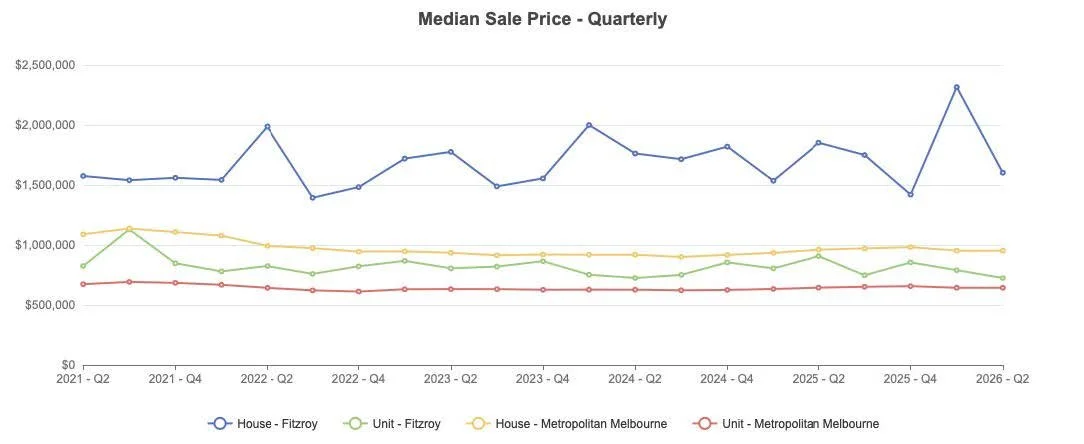
Figure 2: Median sale price quarterly for houses and units Fitzroy (Source: REIV)
The disparity between houses and units appears to be growing. In June 2021 it was 21.2% and in June 2026 it was 36.5%. The report goes on to point out that
“Unit losses within Melbourne and Sydney have also been geographically concentrated within a few key areas. In the June quarter, almost 39% of the national unit resale losses (by value) were located in the local government areas of Melbourne, Parramatta, Stonnington, Port Phillip and Sydney.” (P.5)
These LGAs, and our municipality of Yarra was not far behind, contain some of the highest concentrations of units. The report goes on to point out that Melbourne had the weakest profitability conditions across all capital cities and that “weakness in units [was] negatively impacting this outcome”. P.6 From an economic point of view, this is clearly going to impact a willingness to invest as much as rising costs of labour and materials and the overhang of unsold properties¹.

Figure 3: Proportion of unit resales showing a loss in LGAs identified as showing the greatest loss in value (Source: Cotality Pain and Gain Report September 2026)
For investors, there is less interest in apartments because of the lack of capital gain. Hence the large number of sites being land banked in inner Melbourne (owned by developers but nothing happening even though they have planning approval). This is likely to be a contributing factor to higher rents because an investor needs to achieve their return on capital entirely through rent rather than part rent and part capital gain.
Demand and supply – what is driving demand
As a recent survey (2025) by the Committee for Melbourne found, for most people, the home-owning dream is still a house with land while apartments are seen as second best.
“The findings reveal a clear public preference for outward expansion over upward growth, highlighting the significant challenge of promoting urban densification.” (p.31)
The option of new construction in outer areas was supported by two thirds of residents. This was consistent with an earlier survey in 2024 indicating that building on the city’s fringe is widely seen as the most acceptable solution to housing supply issues. “This makes densification a far more contentious political and social issue.” (p.31). While FRA is not opposed to increased densification in inner urban areas, these comments do support our view that densification will need to consider more than just units of housing and must address questions of liveability particularly for younger families.
“The data shows that a majority of residents do not consider an apartment to be an appropriate place to raise a family (63%.” (p.32)
The report notes that support for density is strong “only when it is directly linked to tangible, positive outcomes that improve liveability”. (p.34)
The Committee for Melbourne report reinforces the point made earlier in discussion about the danger of pursuing a narrow scope for the PC’s report: “This finding serves as a warning: to maintain public buy-in for urban consolidation, the tangible benefits must be clearly communicated and, most importantly, realised.” (p.34)
Cost of regulation
The report acknowledges that housing costs are driven by many factors (p.5), as mentioned above in relations to the scope of this report, you should outline the relative impact of those other cost factors particularly labour, building materials and financing costs. Your statement that “one important answer is to shift policy to make more housing supply available” is, with respect, jingoistic rhetoric without establishing its significance relative to other factors.
Regulatory reform
Your discussion on regulatory burden argues that planning and building controls “impede development or limit the type and number of dwellings that can be built on a parcel of land”. That they are regulatory measures to ensure separation of different types of uses, functioning communities and well-constructed buildings is not disputed. Planning controls have their origin in separating appropriate land uses and in so doing, ensuring appropriate areas for appropriate development (for example separate areas for noxious industries). They also protect the rights of property owners who may have invested their life savings to buy in a “desirable location”. There is a long history in law, dating from the Magna Carta, about the role of government in protecting the property rights of its citizens. This is not a right that should be lightly pushed aside or treated lightly.
Building controls have their origin in fit for purpose construction, consumer protection and public safety (the Grenfell Tower fire in the U.K. is still in the public conscious). Where building controls fail, this often results in a call on the public purse either directly or indirectly. Again, not principles that should be brushed aside lightly.
The Commission should not assume that change in planning rules, particularly zoning, will deliver more housing. U.S. planner Donald L. Elliot argues in his book, An Even Better Way to Zone², zoning is designed to exclude, it “rarely makes someone build what they don’t want to build” (p.17). FRA accepts the planning system can be improved but this is not a panacea for supply or affordability. There are numerous sites in Melbourne that have planning approval but construction is not happening.
How we improve planning systems involves trade-offs that need to be considered in the community as a whole and be in the interests of diverse, sustainable and well-functioning communities. Bad planning, in combination with poor building regulation will result in places that become a centre of gravity for disadvantage. Planning for a concentration of disadvantage will return cities to the time of donut cities; where the centre was regarded as dangerous slums and the wealthy relocated to the new affluent suburbs on the periphery.
Slow, burdensome and cumbersome approvals
It is implied that council and community involvement in the planning process makes it slow and cumbersome. That is not our experience. There is evidence that the development community is responsible for delays and costs of the planning approvals process. When the Victorian Planning Minister appointed a Standing Advisory Panel to review Design and Development Overlays for Fitzroy and Collingwood, the committee considered requirements for height and setback requirements to be mandatory. This was proposed by Council to simplify and speed decisions. The Standing Committee noted that the only voices against this proposal were the voices of developers who wanted discretionary limits, and because this would result in more disputation and delays, the Standing Committee recommended retaining the mandatory limits³. But this was not accepted by the Minister.
Best practice housing regulation
The heading of Figure 2 on page 6 reflects a core problem with this report. The objective of best practice housing regulation as the Commission presents it is not a social outcome, it is a bureaucratic goal. Regulation is not an outcome. To better align the report, the Commission might consider an objective such as “Principles to achieve liveable, well-functioning more densely developed urban communities”. That objective could be articulated as ‘how regulation can support more densely developed, liveable communities offering long-term resilience, sustainability and equity where people want to live and flourish’.
This clearly implies a broader set of best practice principles than your largely economic markers. Your first principle of a cost benefit analysis is a recipe for perverse outcomes given any discount rate applied would make the consideration blind to long-term future benefits and costs. Experience with cost benefit analysis is that non-monetary benefits such as a healthy, liveable community and amenity are unlikely to receive adequate consideration. Healthy communities require consideration of a much broader range of factors than units of housing. How would this principle deal with wind impacts of new buildings and the impact on neighbouring streetscapes?
The quote, at the start of this submission from former federal opposition leader Sussan Ley about her experience from travelling through U.S. cities could just as easily describe the sort of cities the Commission’s best practice regulation could produce. Contrast her comments from a recent Committee for Sydney report on Breathable Density
“Breathable density is density designed around people and nature. It means public space, tree canopy, light, water and fresh air are part of the brief from the start, at every scale of the city, from the suburban street to the high-density tower. The evidence is unambiguous. Quality green and blue space is one of the most powerful health interventions a city can make.” (Density Done Well – Breathable Density, Committee for Sydney, July 2026)
Looking at the other Principles:
• Principle 1 is too narrow and a recipe for disaster resulting in cities that lack personality and social fabric and as the Committee for Melbourne report argues, counter to the goal of densification. The emphasis must be broader and longer term to reflect issues people, particularly working age people needing access to transport, consider important if they are to be attracted to more densely developed cities.
• Principle 2 is subjective and ignores the real world where it is to be applied. For a start it implies that major defects are known in advance. That is unlikely to ever be the case. It would increase inequity and long-term costs to those who are least able to afford those costs. For example, removing climate-related measures from the code would become optional under the PC proposal. This would mean lower income people will have higher energy costs and potentially less heat protection leading to poorer health outcomes and potentially higher rates of mortality.
• Principle 3 is supported but needs to be expanded to include open space, tree canopy, common areas for people to gather, meet and congregate. Developers in new suburbs should meet the vast majority of these costs to avoid government continuing to subsidise urban expansion.
• Principle 4 we would broadly agree but under the objective we have proposed, it would align with a more inclusive goal for denser, liveable communities. As discussed above, in Victoria, those who argue for this goal – government and developers – are the ones who undermine the ability of the planning system to make timely, predictable and simple decisions.
Mid-rise, high-rise
In advocating for mid-rise and high-rise in high demand areas, the Commission fails to consider the impact of those buildings on liveability and the very things that often make those areas attractive places to live. High-rise and mid-rise buildings take away sunlight and accelerate wind making the streets less attractive for pedestrians, social purposes and vegetation. High-rise creates an indoor focus because the streets are dark, windy and more dangerous. Streets in Fitzroy, for example, are relatively safe despite the high population density and the proportion of people with problems because there are a lot of people in the street. High-rise buildings such as those at the Australian Catholic University in Fitzroy accelerate wind and the area around the campus rarely has people, only students scurrying to the tram stop. Iconic streetscapes such as Victoria Parade rely on sunlight to maintain vegetation cover. Tall buildings would rob these areas of sunlight making them less liveable.
"Original planning for places like Docklands and Southbank was to create really high-quality liveable suburbs, low-to-medium-rise housing with a European model of development, and we ended up with high rises and the development industry making the decisions about what goes where.”
Professor Michael Buxton emeritus professor of environment and planning at RMIT University
Heritage controls
The Commission has failed to understand the role and importance of heritage controls. Again, this is inherited from the Grattan Institute and YIMBY Melbourne and should be acknowledged. Both disregard the importance of streetscapes economically, socially and environmentally. Melbourne’s heritage streetscapes have an important economic role in attracting tourists and generating local business. Just as in European cities where the ‘old city’ areas are where tourists like to spend their time, suburbs such as Fitzroy attract tourists to our streetscapes and the businesses that spin-off those streetscapes (bars, restaurants, coffee shops, clothing retailers etc.). The streets of Fitzroy attract visitors from overseas, interstate and other parts of Melbourne and Victoria. Grattan Institute, YIMBY Melbourne and the Commission have failed to consider the economic benefit of heritage streetscapes.
“Beauty is not subjective. We all know where tourists like to take photos and it is not the Australian suburbs. Evidence overseas shows that building ugly is not an economic necessity and that beauty pays. We also know that local traditions and strong, unique character draw both new residents and tourists alike. But no-one can tell which country nor even the continent from looking at our new inner-city buildings.’ Juri Lev, architect.
Young Tasmanian Architect Juri Lev, standing for State parliament championing successful international examples of mixed-use, low-to medium-rise developments that feature dense urban greenery and diverse public spaces. “We must make a stand before we lose even the last remnants of our uniquely Australian building culture to globalised anonymity.”
It is not just economics and aesthetics that justify heritage streetscapes. Considerable work has been undertaken in the U.K. on the value of streetscapes. They play an important social role (what makes a desirable place to live). In our own (FRA) resident surveys, the main reason people like living in Fitzroy is its sense of community. A report In the UK on heritage and pathways to wellbeing, found that 80% of people thought local heritage makes their area a better place to live. Heritage streetscapes play an important social role that give people a sense of belonging and community. That make a place liveable.
Infrastructure contributions
The report considers in several places developer contributions to infrastructure. While we see these as important, particularly in new suburbs, for existing suburbs such as Fitzroy it is important that developers of apartment buildings contribute to expanding open spaces, areas where people can encounter nature, relax or picnic, exercise or walk their dog. Increasing density is placing enormous demand on existing open spaces. The threat of losing more open spaces as the Victorian Government threatens to demolish public housing towers, triple housing in the same area and add office and retail spaces will see a net loss of open space and canopy at a time when we need more. In addition, increasing use of the Development Facilitation Program by the Victorian Government means council is not collecting an open space contribution from these developers. Any contribution goes to the state government where it could be directed anywhere in the state or not directed at all.
Car parking
The report argues that removing minimum car parking requirements will lower costs per unit of housing. This is self-evident. It will also lower the price a potential buyer is willing to pay. This may suit some buyers in areas where there is good public transport. However, our lived experience shows that this will increase demands for on-street parking creating congestion, frustration, conflict and removing space for alternative transport modes such as pedestrians and cyclists, areas for visitor parking and areas available for vegetation and street-scaping. This will lower the value of the neighbourhood as a whole. In effect, if the number of spaces are inadequate, the whole neighbourhood pays the cost.
Tree canopy
Areas of greater urban density such as Fitzroy already face a deficiency of tree canopy; a vital part of climate adaptation given expected heating impact of climate change particularly in urban areas. More intensive development is removing much of the private tree canopy previously available in front and back yards of houses that are replaced with town houses or multi-unit developments. This problem has already been identified by council officers. It requires a more thoughtful and considered approach to densification.
Market failure
There is an assumption in the report that private developers will solve a shortage of housing if freed of regulation; if the bar of planning and building regulation is lowered sufficiently, developers will build something that can be sold as a home. Developers are motivated by profit, they will only build if they can see there is a willing buyer who will pay the cost of construction plus a profit margin. The attitude in government that they need to do whatever developers ask and eventually they will build and solve the “housing crisis” is a fantasy. Even one of its chief advocates, Brendan Coates of the Grattan Institute, admitted under cross-examination by a Victorian Parliamentary committee that is was an experiment.
Australia’s property developers have grown fat over the years through easy money made during a prolonged period of increasing prices for housing. A rising market that covered all sorts of failures. The industry lacks innovation and either the interest or the ability to improve productivity. It is easier and cheaper to run a PR campaign that can capture government and the national narrative than to find productivity improvement. Governments under fiscal pressure, unable to use their economic power to address the current market failure are willing accomplices in perpetuating the myth that all this activity will create homes that people can afford in places that they would like to live.
In the immediate post-war period of the 1950s and 1960s, governments took the lead on housing through technocratic agencies such as the Victorian Housing Commission. That agency may not have always got things right, but it (and other agencies) used the economic power of government to acquire and develop land and build homes to accommodate the post-war immigration boom. In Victoria, prefabricated homes were constructed by the agencies to create homes in inner suburbs and on the city’s fringes. The Productivity Commission should focus on what government can do to address the current market failure; where government can get the best value for investment in housing. Not simply taking from the commons and lowering standards to little more than a Bombay slum.
¹ See for example https://charterkc.com.au/addressing-the-challenges-in-melbournes-apartment-market/
² Donald L. Elliot, An Even Better Way to Zone; achieving more affordable, equitable, and sustainable communities, Island Press, Washington DC, 2025
³Yarra Activity Centres Standing Advisory Committee Report 5, Vol 1 11th June 2026 (Version 3.0) P.14.